
Weight of Comfort
Thousands of tiny electrical sparks are racing just under the skin. Not pain exactly — more like noise. Constant, low-level interference that’s felt. A hair falls on the forehead. Oh, it’s there. THERE. A draft moves through the room, felt on the neck. Goosebumps right away. There’s a dry patch on the back that can’t be reached with calming cream — focus caught between the shoulder blades. Each of these details — a signal. Each is strong. The nervous system refuses to ignore the knocks. Or more. It flashes up — knock! alarm! knock! alarm! knock! alarm! knock! alarm! One after another.
This is how my hypersensitivity works.
Eyes, ears, and skin register everything. Much of it tempts, intrigues or annoys. Everything demands a great deal of attention. And it gets it. No matter the cost.
I learned early that weight helps. Heavy clothes, long sleeves, thick cotton, layers that cover, press down. And having my hair neatly tied back at all times. I didn’t understand it as a child. I just knew that my favourite hat and a chunky hoodie felt safe, like armour — they still do — and a thin shirt felt like being constantly exposed to “too much”.
I have autism. This is not a sad story.
For me, it’s quite a good one. Given a chance, I’d never change my mind. Autism is a great operating system to run on. Like Linux — unpopular in the mainstream, but it’s the one people send to space and back. It does the work well, elegant within its structures. Yet the first thing seen is the interface — more demanding, less user-friendly. Not for everyone.
My type of autism comes with specific features. It runs on hyperfocus that locks in hard. Here is the gold: the ability to lose myself in literally anything and find it genuinely fascinating. I sense something, my mind lights up and takes it — as it is — takes it all. Autism is a curse; it’s known as such. I can’t disagree fully. But it has elegant software. Good for love. And good for work. This attention, problem-solving, thinking in beautiful forms. Finding an angle to get that perfect view. And showing that angle.
But with such a complex program, this operating system often runs hot. High performance comes with high maintenance.
I get so absorbed. I don’t see the world around. Including a big part of myself. All the sensory signals keep coming — thirst, hunger, tiredness, pain — but tuned down so as not to interfere with the main — focus has taken the throne, and it rules. It goes HYPER. The rest of the kingdom — is silenced, queueing in the background, hanging on to poor nerves. For a time.
No authoritarianism holds for too long.
I finish working — then — BAM — everything comes into the foreground. Sometimes, just hitting hard. Sometimes, a revolt on my already tired mind.
Then something breaks. I become a discharge lamp. I swear. I can see the chaotic rays over every surface — O V E R — every — S T I M U L A T I O N. Discharge jumps. Everywhere. Making me too wired to sleep, too depleted to function. I’m lying down on static. The body wants rest. It begs for it. Pain in all nerves. But the transmission is on and loud. ON. On all channels. And the mind collects it — all — no matter.
A catastrophe. That could be predicted. Prevented. But once I fall into a trap, the choices no longer have enough weight to push back. The body takes over and gives me a ride. Rollercoaster. Circuits burning. All emergency lights on.
Something must be done.
Luckily, I am not the first person with this kind of mind. Temple Grandin had similar, and she built herself a hugging machine — a device that applied firm pressure to her body when it became too much to hold. I understand that impulse. When my system gets too reactive, I need a switch to turn it back down. Not words, but a soothing constant. A physical signal to override all the jumping rays.
Weight.
This is what a weighted blanket does. The concept is simple: a patchwork of small squares filled with glass beads — heavy and nicely cold. When a person gets under, it applies even pressure on the skin. The nervous system responds. It likes that weight. It takes it. The information comes and grows around: stop being on alert. Calm down. Slow down. It’s all okay.
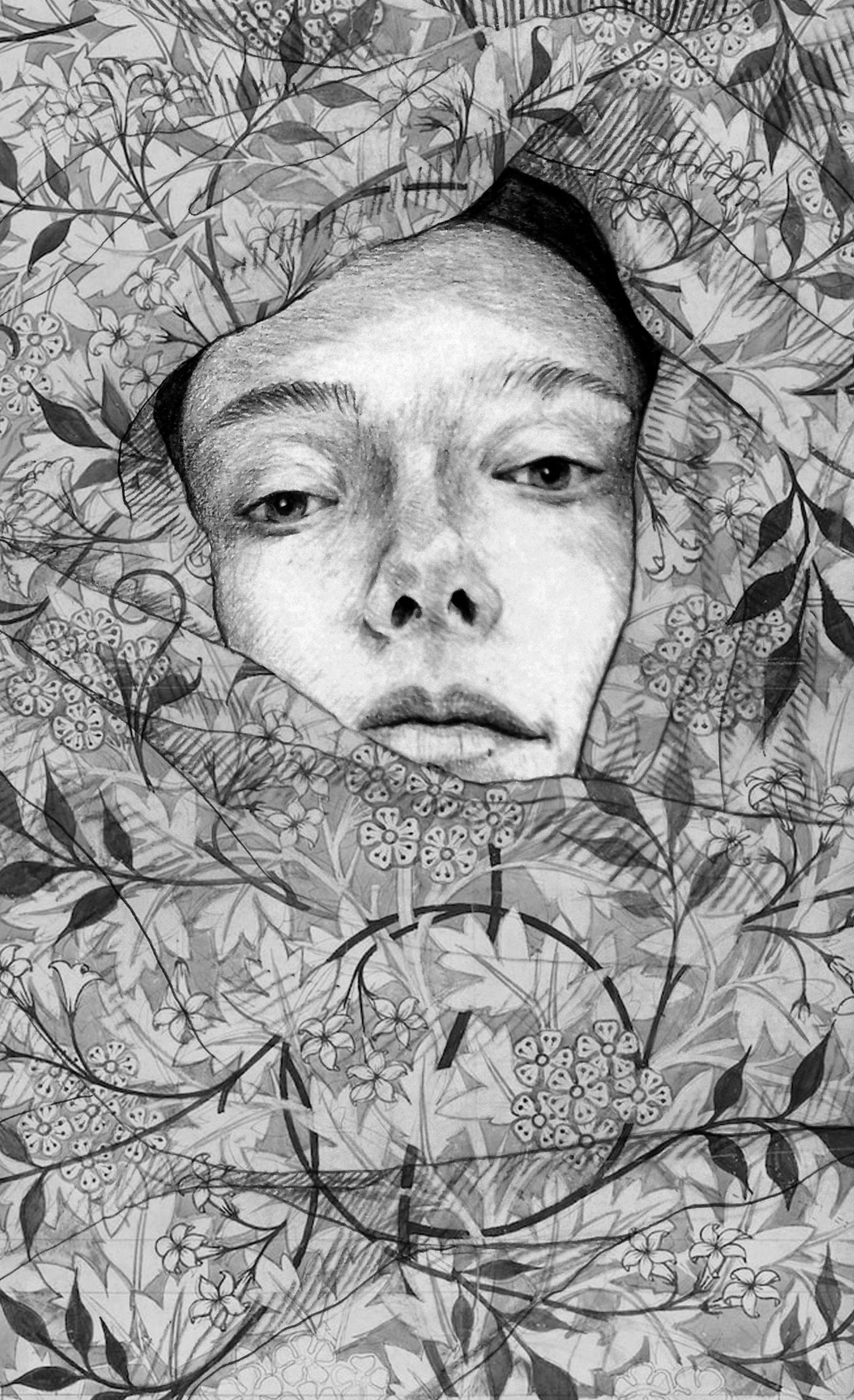
The weight of comfort — Mira Maria Belniak, pencils on paper, mixed media, A5, 2017
For me, it works like a magic trick. Pushing a reset button. I climb under my 12kg blanket after a day of running hot, and, within minutes, the static begins to fade. The sparking, the pain, the noise — go away. I can breathe. Again. Finally. And often fall asleep faster than I could expect. A blessing.
Yet not a cure. No weight can stop overstimulation from happening. That’s on me, I guess. But a heavy blanket is a genuine tool — a piece of equipment that helps. Put the high-maintenance system under, and it will cool down. No circuit is burned. Less damage.
It works. Not only for autists like me.
This essay is my thank-you note. To Temple Grandin, because she made some lives, mine included, much easier to manage, like, and translate to others.