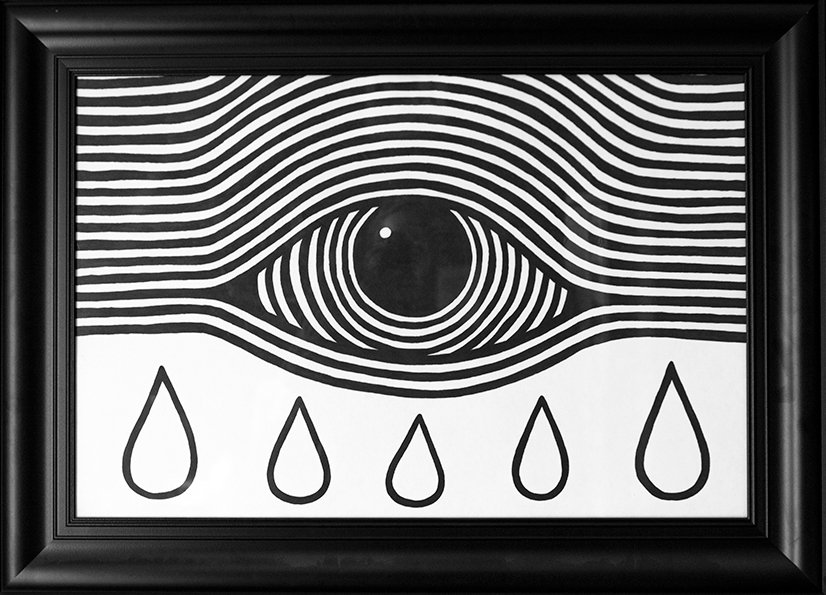
Whale’s Eye (1:1) — Mira Maria Belniak, marker on paper A1, framed, 2019
Whale’s Eye (1:1)
The whale is endangered, while the ant continues to do just fine.
— Bill Vaughan
Whale’s Eye presents a single eye of a blue whale, rendered in black marker at a 1:1 scale and mounted in the largest available frame. The composition is deliberately constrained — the eye fills the picture plane entirely, its concentric lines radiating outward from a solid black pupil in a pattern that oscillates between biological form and optical illusion. Below the eye, five teardrops are arranged in a row, drawn with the same stark, graphic line. They sit in open white space, detached from the body they came from, as if the emotion has already separated from the creature that produced it.
The work uses the blue whale — the largest known animal ever to have lived — as a metaphor for social nonconformity. In a society that rewards predictability and penalises deviation, those who grow beyond expected parameters find themselves increasingly isolated. Education, ambition, confidence, independent thought — these are the mechanisms of growth, and growth is what pushes an individual beyond the frames that social structures provide. The ant is accepted. The whale is incomprehensible.
Belniak’s choice to work at true anatomical scale is central to the piece. The whale’s eye, roughly the size of a grapefruit in life, is one of the few parts of the animal that can be faithfully reproduced within the dimensions of a domestic frame — and even so, it barely fits. This tension between the real and the containable runs through the entire work. The teardrops speak to what that tension costs: loneliness, misunderstanding, exclusion. But also to what it affords — the irreducible freedom of being too large to be categorised, too distinct to be controlled.
The piece is executed with deliberate economy — black marker on white paper, no colour, no shading, no tonal gradation. The visual language borrows from op art and graphic illustration, but the content remains personal and political. It asks a simple question with no comfortable answer: what happens to those who cannot be made to fit?