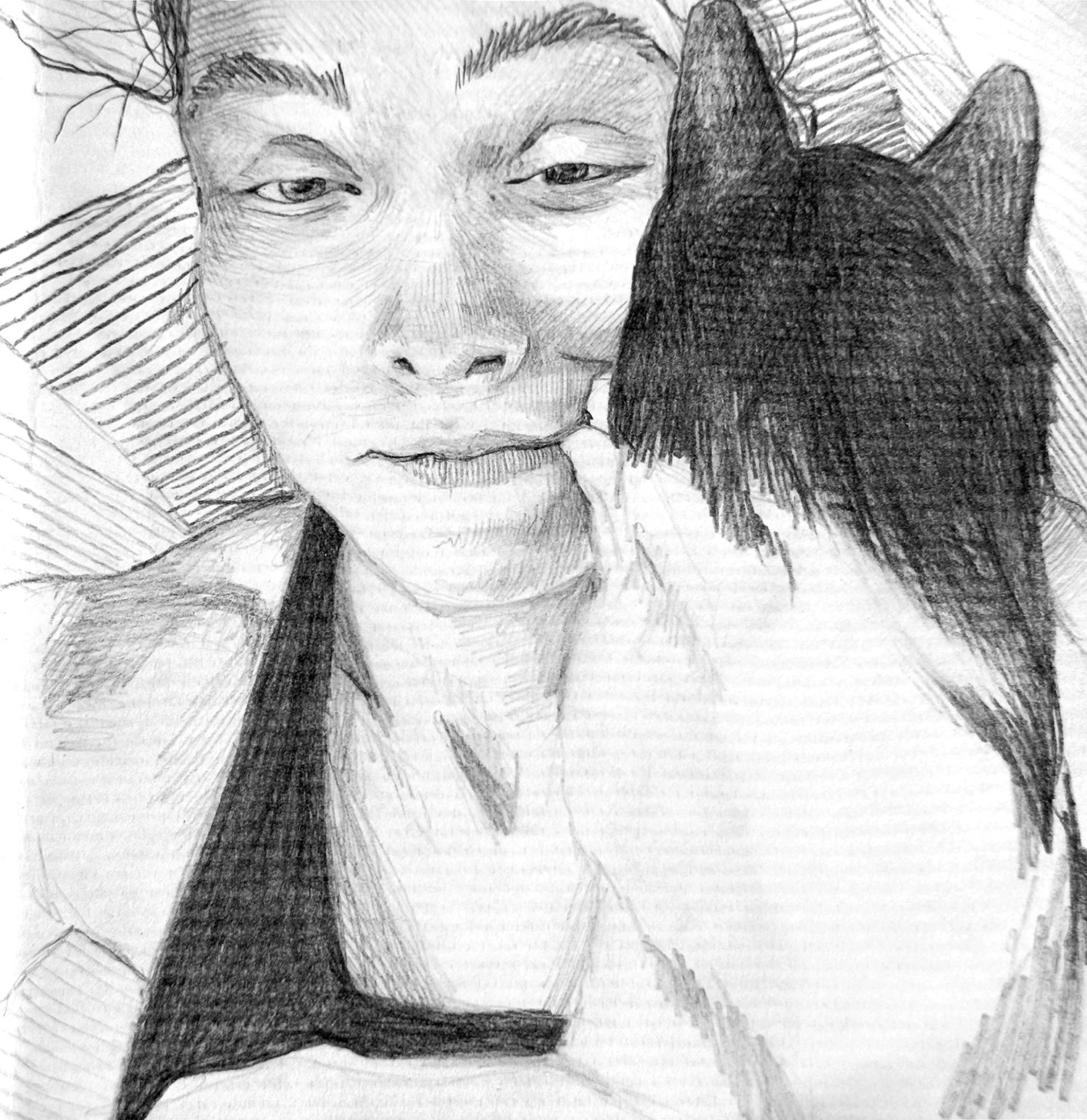
Sketching Cats | Field Notes
The pencil hovers. The cat sits still, tail wrapped around paws, eyes half-closed. I take paper and pencils. I start to draw. I make the first lines. Then — a twitch of whiskers, a turn of the head, and the pose is gone. This is the problem with sketching cats. They like to stay still, but they also like to shift their state in one blink of an eye. Without warning, they go from rest to alertness to movement. Blink twice, and they’re gone. If you are an artist, you must count on the moment and be prepared to have your model for a limited time.
A challenge.
Yet artists love to draw and paint cats. We can see them on ancient tombs, woodblock prints, paintings, and countless digital works now. Cats have been drawn everywhere for thousands of years, even though they have rarely cooperated. Annoying muses but also so perfect.

Paradox of form
A cat’s body hides amazing contradictions. The same paw that moves gently and softly like a little furry cloud can release sharp claws in an instant. The lovely creature that invites a touch can bristle into a pointy threat, and back to soft pet, in seconds. Depending on its moods, and never apologetic, never explaining. Look into these eyes with pupils that can sit as narrow vertical slits or be two circles wide and full of excitement — a master shapeshifter built from tiny details.
A relaxed cat looks like a furry liquid form. It fills a box or a pot, or lengthens itself until it spills over and off the sofa. It can squeeze itself, or it can go wide, like it forgot it has bones — whatever form the king or queen wants, it gets into. Relaxed, like water, alert like a bow: arched back, stiffened legs, all muscled up, fur puffed out on the tail, it doubles its size again, but in a hard way. A shapeshifter, what better word for this set of possible changes?
Tail up, bristling fur, the cat disagrees. Tail down — it changed its mind — the cat is now at ease. But wait. That tail is twitching at the end. Is the cat irritated, or focused? But the tail moved again as the cat sat down, wrapping itself tight around. Is it cold, or keeping to itself? What story does that cat tell in its own language? I can feel the meaning in every one of the littlest moves.
Twitching lines
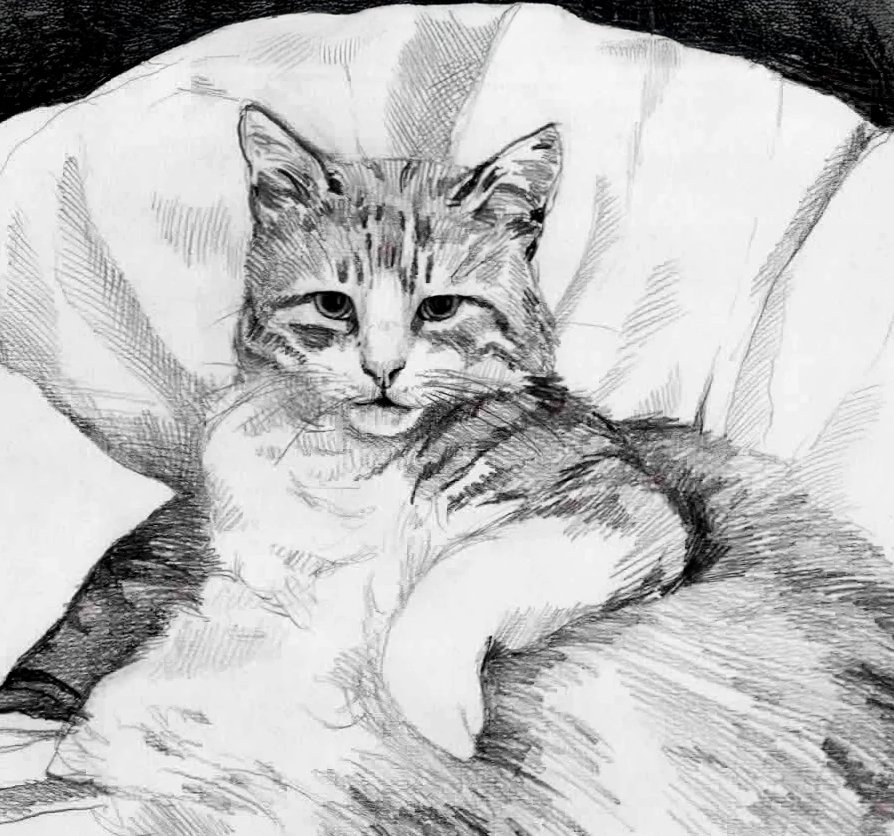
Cats usually don’t wait for anyone. Always in readiness to change the form. Alert — a little more, more, less or a little less. Even a sleeping cat will rotate its ears toward sounds while the rest of the body rests. How do you draw a subject that moves so much if not together with these moves? At least noting them in lines of sketch that are visible on the finished piece. There was a move — this ear, this paw, the fur under a blow of air — the lines say. It’s alive. It’s a cat. Not a stone, not a sculpture that never makes a twitch, but a living, amazing thing. Leave that sketch unclean. It should show the real thing.
Problem of fur
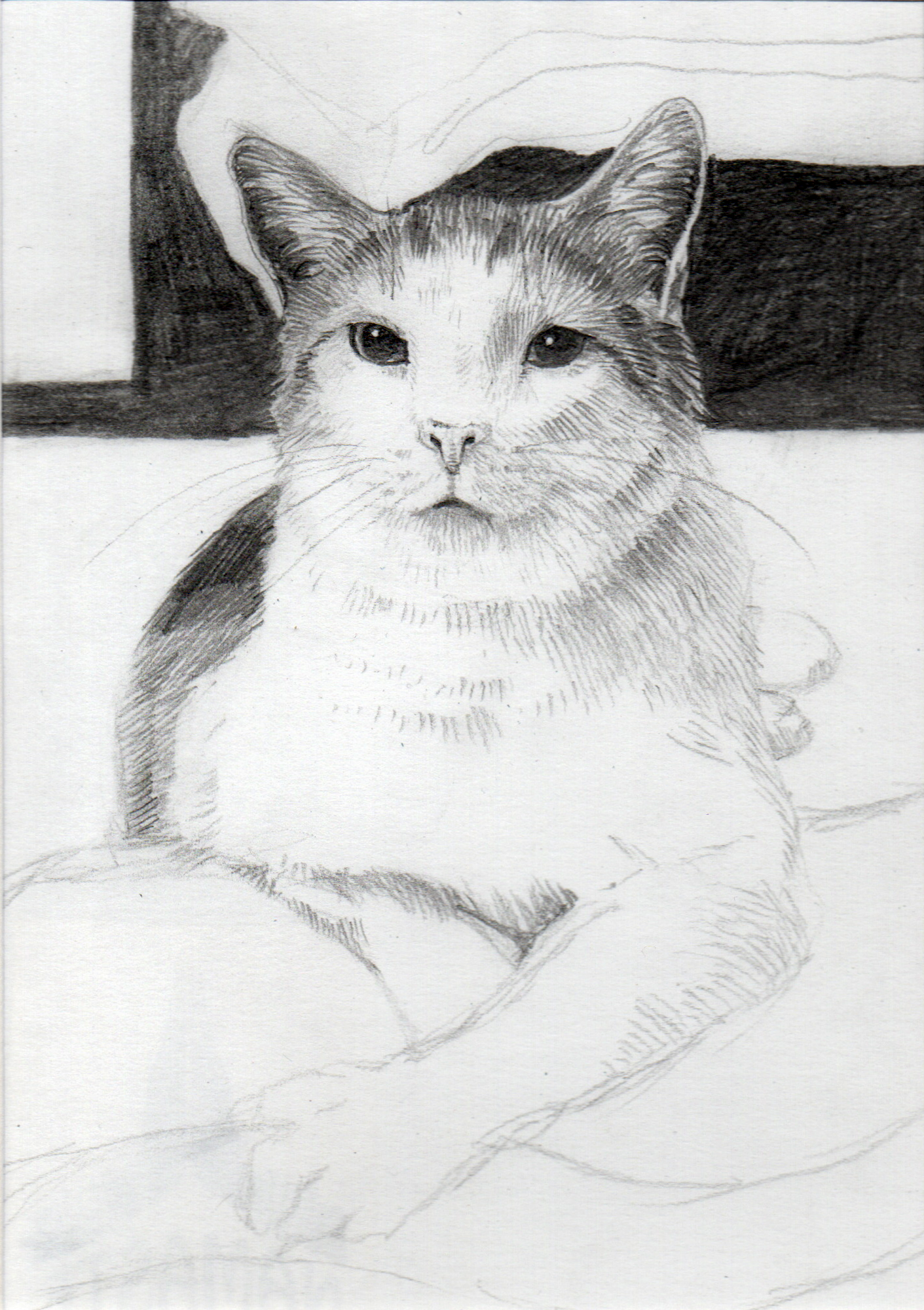
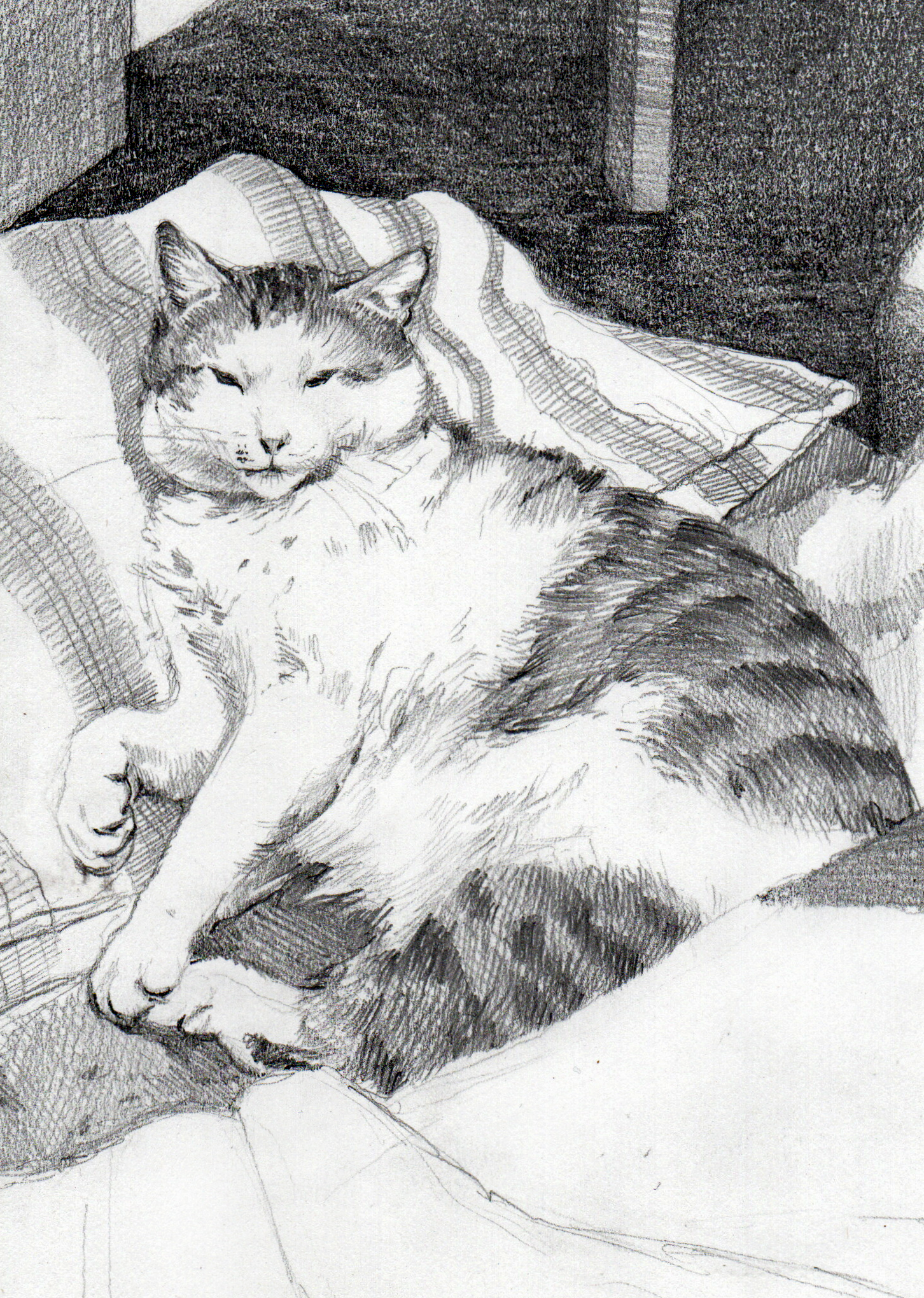
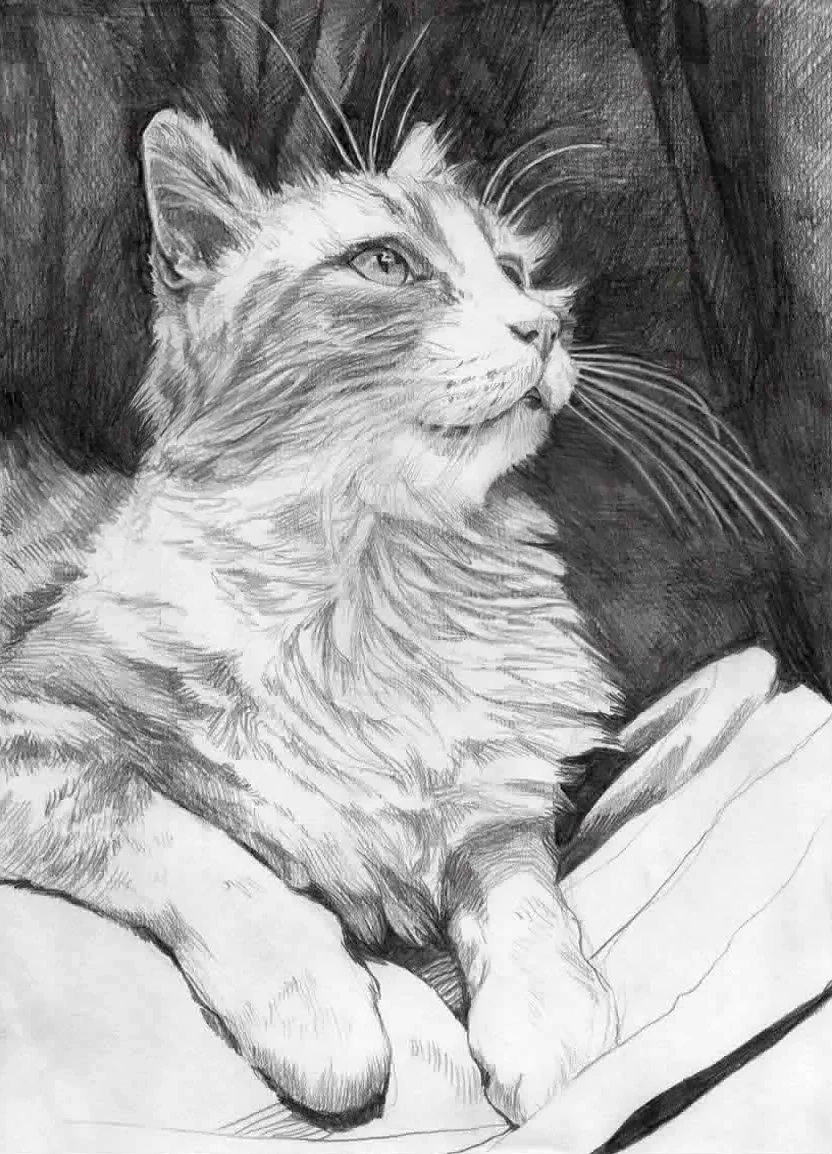
Cat fur is a challenge for many artists because it grows in various directions and because it is, in fact, many different types of fur. And this difference is not only from one cat to another. Look at this cat’s head. Look under its long whiskers — I can almost see pink skin around the nose. Further along, the fur becomes increasingly dense. And much longer, a bit curly at the cheeks, more straight and shining along the spine. And again short, down, on the paws. And the softest, thinnest fur on its belly.
The colours of a cat’s fur also often vary, from white and black cats, tabby cats, calico and blue, to tortoiseshells. Fluffy orange with white paws. Striped hips. Colours mix, change from one to another across the cat’s furry body, challenging artists’ skills and pencil choice.
Fur also moves. A calm cat’s fur lies softly on relaxed muscles. But a cat can go from sleek to twice its size in under two seconds just by putting all that fur up. Better if there’s no draft, because the lightest breeze will move the fur.
And there is also the other side of the challenge of the fur. You make lines that may land too heavy, too dense, hard, too solid. So, opposite to what you can touch. Cat wouldn’t wear that fur. It must have the air, it must shine where it shines, if you want a real cat’s fur.
The particular muse
Every cat is different, specific. Even if, at first glance, you think these Siamese cats are like clones, look closer: they are not. To capture a cat, that particular cat, is to capture its individual features. Just a few. Even one can do at times, if strong enough. It’s in its look — slight squint, characteristic line, whiskers’ length — and also in how it moves, or in the feeling of its fur that is softer or heavier than on other cats, or what it likes, when its ear twitches, how calm it sleeps, how it tends to bend its tail, and why. It can be drawn. And when drawn, it shows that one special cat. That’s respect for the muse to show it as it is. If I catch a few of its special marks, I’ll have done my job well. I passed. The drawing will show THAT cat, not ANY cat.
The unknowable
What hides behind a cat’s eyes that they shine so much? What does the cat think when it poses? Does it even know it’s drawn? Probably not. But what moment of the life of that cat lands on the paper under my hand? Only it knows. But whatever it is, it can mark the drawing. I caught myself thinking: Punky lies down there, and he thinks about what I do, he’s constantly watching my pen; and: I can feel how Lucy judges me when I draw; or: just look at her, she sleeps so calmly, must be a good dream. And the drawing will show how I read the cat. It will show what I think of it when I draw. Even if I can never know what the cat really thinks.
Softness and warmth
A cat, a predator in a coat, sharp and soft at once. Feel the softness, come close. And sit. Drawing softness means slowing down. Touching the paper more softly. Taking the feeling and giving the feeling, you can’t cheat it with a heavy line. Heavy is not soft. It’s a pleasure to draw softness. And I like to sit close to a soft cat, but the cat likes it when I sit still, so it often jumps onto my lap. A mellow cloud with some weight, giving me warmth. I put my hand on it to gently pet its back — my fingers dip into its hair. I feel I get as much from this touch as the cat gets. And then — the purr comes — the cat starts to vibrate. This makes me forget all — to draw, to think, where I am. The cat is happy, and so am I. Only the paper stays blank.
Play and mischief
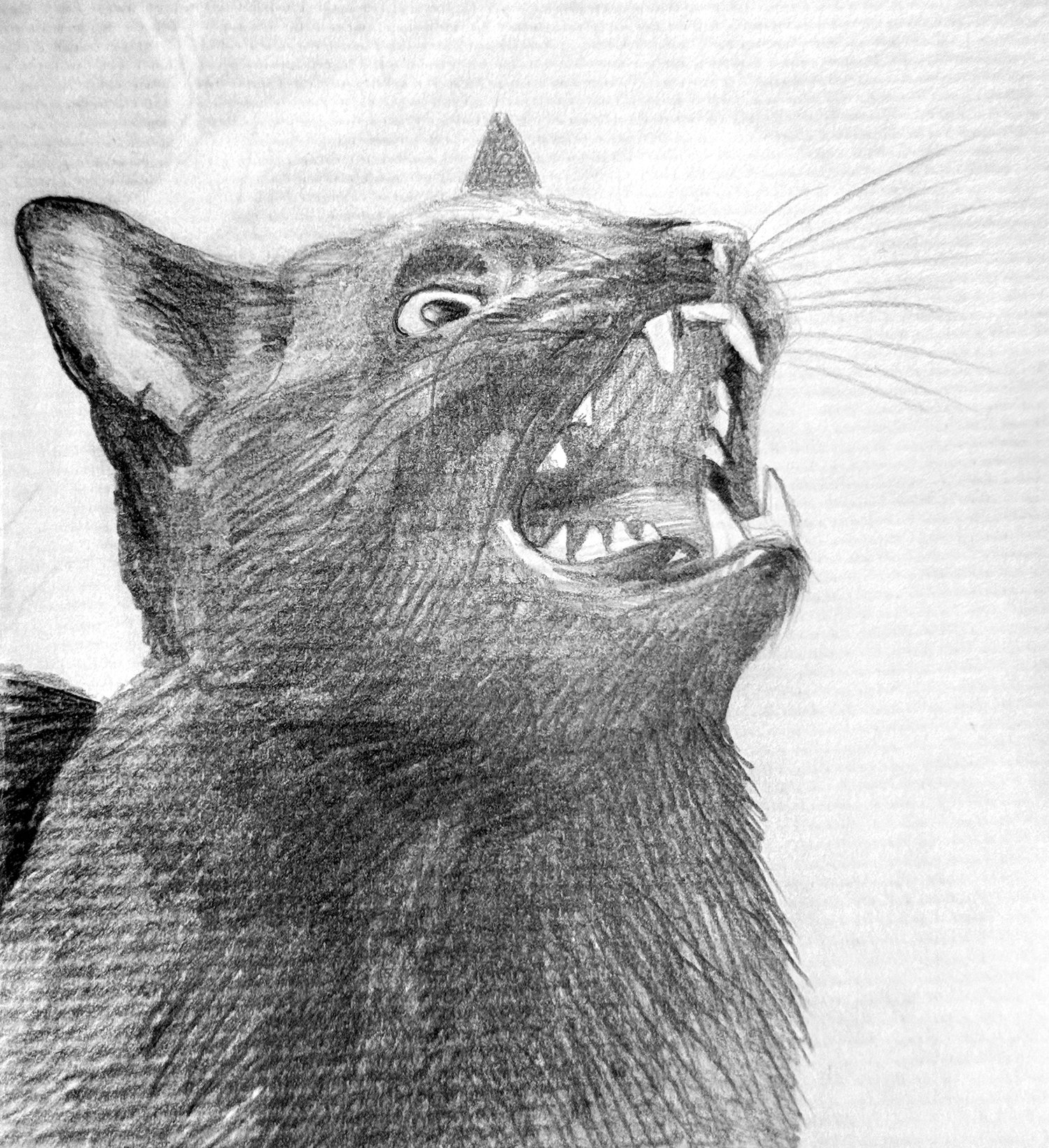
A cat at play becomes something else — when it attacks, it stalks, prepares, then jumps, claws first. Fur in the air. And sometimes you think it’s calm, it just sits there, and then, suddenly, it bats an object down. And runs.
To draw a cat that follows its hunting steps: stalk, chase, pounce, grab, bite, my hand must be as fast. I’d better prepare my eyes earlier to catch as much detail as I can, and I won’t be able to sketch. The next occasion for the same spectacle may come in a moment or may not happen at all. I have a bigger chance to draw a slow stalker than a fast pouncer, and almost no way to draw an angry, crazy cat — motion itself personified.
Speed does something interesting on both ends. While looking, I have enough time to catch only the essence, the general shape, the move. Details have no chance; they are lost in the move. It’s unsettling — and a fantastic exercise for an artist’s eye. And following the eye, the hand moves — fast, fast! Stroke after stroke, quick! Don’t think. Be only eye and hand. Note that move, mark that paw, point the ear. A twist here, an arch there. The cat did the last jump, and it’s gone. The paper shows how much I grasped from the view. It’s never all of it, but it must do. Trying to add more later is risking fiction.
I’m being trained.
Incompleteness is honest
None of my drawings ever captured everything that a cat is at once — and that’s fine. A drawing simply cannot hold the cat as a whole. Only a glimpse. One aspect of the cat. Or two. The attempt to draw a cat that yields the best results is when a moment is caught by the eye, and the pencil translates that blink well enough. One detail captured well can reveal more than a drawing of it all ever could. Eyes are not meant to see the definitive. Drawing honest fragments and leaving cats unfinished seems to be enough.