
Prince Bear
Polish legend from Mazovia
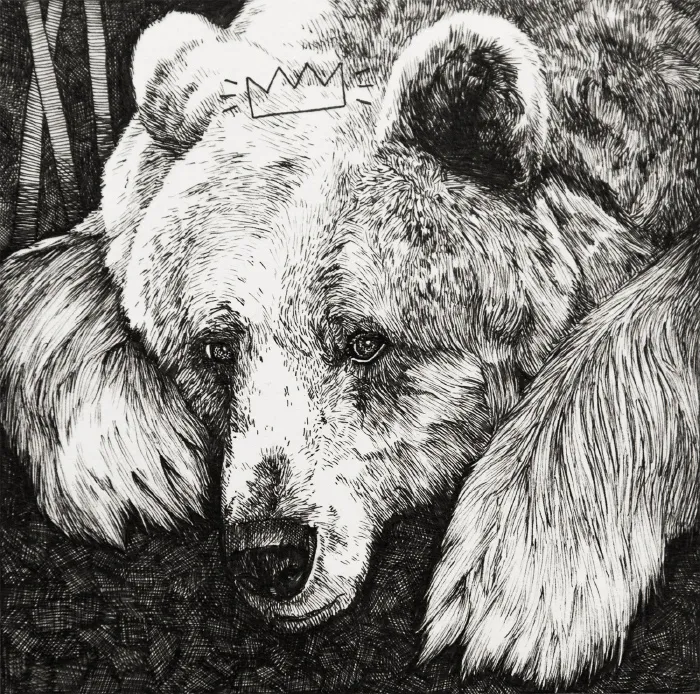
Prince Bear — Mira Maria Belniak, ink on paper, 10×10 cm, 2015
One Sunday, during mass in the Jesuit church in Warsaw’s Old Town, the prince noticed a young woman seated among the townsfolk. She was not of noble birth. Nothing in her dress marked her as special. But her movements were calm and graceful. She listened attentively. When she stood, the light from the high windows fell across her face. He returned the next Sunday. And the next.
He stood where he could see her, always at a distance. He had faced hunts and border disputes without hesitation, yet he could not cross the few steps that separated him from her. Each week, he told himself he would speak after the mass. Each week, he remained silent.
Then came a Sunday when he finally resolved to act. He gathered his courage and waited near the church doors. When the mass ended, the young woman stepped out dressed in white.
A man walked beside her. Family followed. Bells rang.
It was her wedding day.
Prince Bear stood still. He said nothing. He watched.
And something inside him gave way.
A single tear marked his cheek. His body grew heavy. His breath stopped. His flesh hardened. And there, at the entrance of the church, he turned to stone. And so he remains. Those who know his story touch his head as they pass — to ease his sorrow, to greet him kindly, or to ask for luck in love.
Here is where he stands: Jesuit Church, Świętojańska 10, 00-288 Warszawa (Google Maps)